
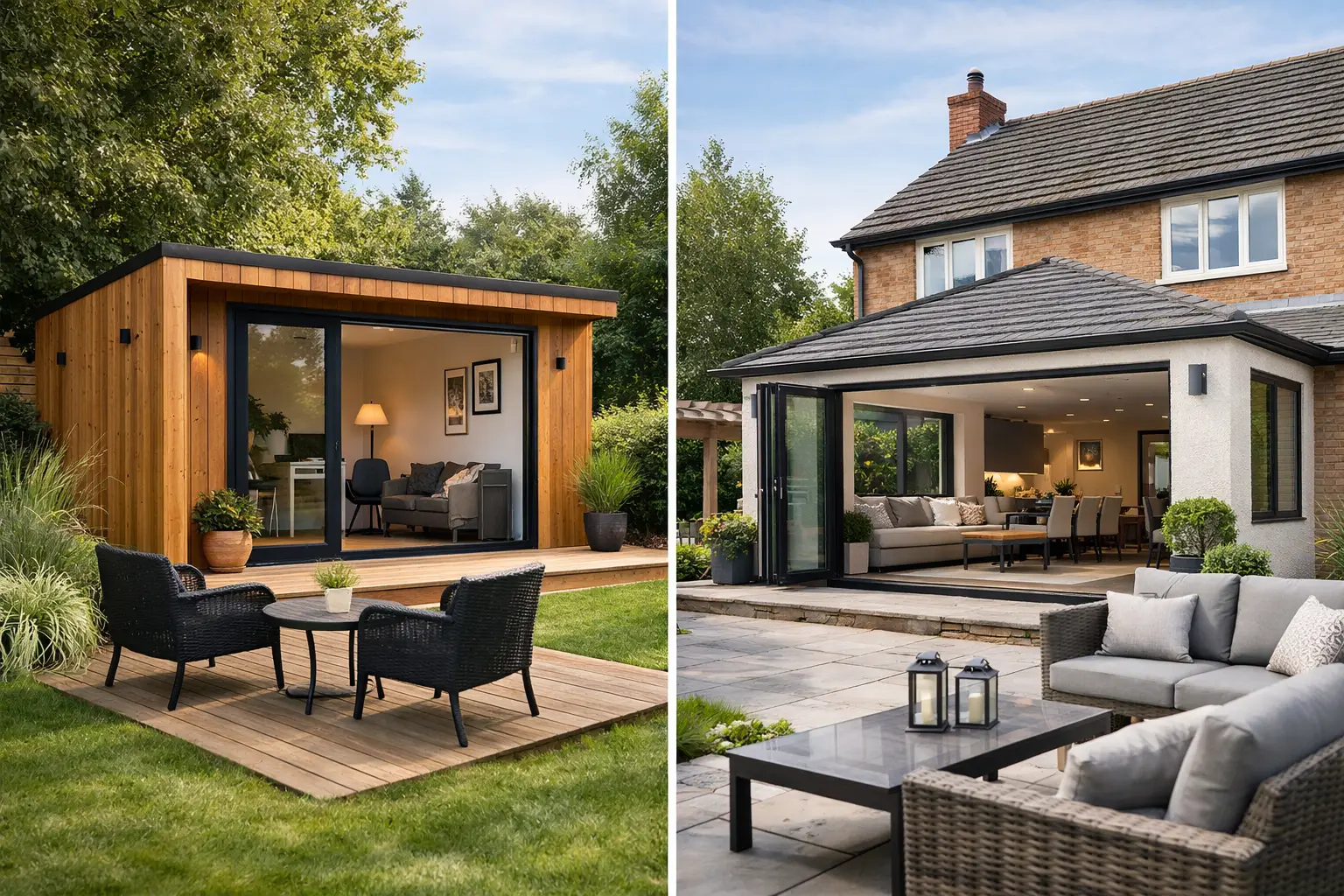
When homeowners compare a garden room vs extension, the real question is usually simpler: where will this new space work hardest for your family, and what will it take to get it right? Both options can add usable square footage and improve day-to-day living, but they solve different problems. The best choice depends on how you want to use the space, how connected it needs to feel to the house, and how much disruption, budget and planning complexity you are prepared for.
Garden room vs extension: the core difference
A garden room is a separate structure, usually built in the garden as a self-contained space for work, exercise, hobbies or relaxing. An extension expands the footprint of your house and becomes part of the main home. That difference matters more than many people expect.
If you need a room that feels fully integrated with your kitchen, dining area or family space, an extension is normally the stronger option. If you want some distance from the noise of the house, a garden room often makes more sense. One creates continuity. The other creates separation.
That is why there is no universal winner in the garden room vs extension debate. It comes down to how you live, not just how much space you can add.
When a garden room is the better fit
A garden room suits homeowners who need flexible extra space without changing the internal layout of the house. It works particularly well as a home office, studio, gym, treatment room or teenage hangout. Because it sits away from the main building, it can feel calm and purposeful in a way that a spare room rarely does.
For many families, that separation is the main benefit. If you work from home, walking a short distance across the garden can create a clearer boundary between work and home life. If you want a place for older children, guests or hobbies, it gives everyone more breathing room.
Build time is often shorter than for a full extension, and disruption to the house itself can be lower. In practical terms, that can mean less mess inside, fewer days with parts of the home out of use, and a simpler route to gaining extra room.
That said, a garden room is not a direct substitute for a proper extension. If you need a bigger kitchen, a more open-plan ground floor or a larger living area connected to the rest of the house, a detached garden building will not solve that.
When an extension is the better fit
An extension is usually the right answer when the problem sits inside the house itself. Perhaps the kitchen is too small, the dining space is cramped, or the ground floor layout no longer works for family life. In those cases, adding to the main structure can transform how the entire home functions.
A well-designed extension can improve flow, natural light and everyday practicality. It can allow for a larger kitchen-diner, an extra reception room, a utility area, a downstairs shower room or a more useful entrance space. Rather than adding one standalone room, it can reshape the way the home works as a whole.
That integration tends to make extensions better for permanent, daily living needs. If the space must be used morning to night, in all seasons, and by the whole household as part of normal family life, an extension often offers more long-term value.
The trade-off is that extensions usually involve more structural work, more interaction with the existing house, and more disruption during the build. Depending on scope, there may also be more design, planning and building control considerations to manage properly.
Cost: what homeowners often get wrong
Cost is one of the first things people look at, but it is often compared too simply. A garden room may appear cheaper at first glance, and sometimes it is. But the true figure depends on size, specification, ground conditions, insulation levels, glazing, electrics and intended use.
A basic garden room used occasionally in fair weather is a very different product from one designed for year-round comfort with high insulation, quality finishes and dependable heating. Once you move into premium specifications, the cost can rise quickly.
The same applies to extensions. A straightforward rear extension with a simple layout is different from a project involving structural alterations, steelwork, drainage changes, roof lanterns, bi-fold doors or a full kitchen refit. The extension itself may only be part of the overall spend.
So in a garden room vs extension comparison, the better question is not which is cheaper in abstract terms. It is which gives you the right type of space for the money you are investing. Paying less for the wrong solution is still poor value.
Planning permission and regulations
Planning is another area where assumptions can cause problems. Some garden rooms fall within permitted development, but that does not mean every design will. Size, height, position and intended use all affect what is possible. If the building is too large or used in a way that changes its status, further permissions may be needed.
Extensions can also sometimes fall under permitted development, but again, it depends on the property and the scale of the work. If you live in a conservation area, a listed building, or a property with restrictions already in place, the rules may be tighter.
Even where planning permission is not required, building regulations may still apply. This is especially important if the space is intended for regular, comfortable use. A professional approach at the start helps avoid costly corrections later.
Comfort, usability and all-year performance
A room that looks good in July but feels cold and damp in January is not adding much to your home. This is where specification matters.
An extension is naturally part of the heated envelope of the house, so achieving year-round comfort is usually more straightforward. It shares the same general standard of construction and can feel entirely consistent with the rest of the property when done properly.
A garden room can also perform well throughout the year, but only if it is designed and built to that standard. Insulation, ventilation, heating, glazing and build quality all play a part. Homeowners sometimes underestimate this and expect every garden room to function like a fully integrated living space. Some do. Some do not.
If your new room will be used every day through every season, this deserves close attention.
Which adds more value?
Both can add value, but they do so in different ways. An extension often has a stronger effect on market value because it increases the practical living area of the main house. Buyers tend to understand that immediately, especially if it improves a kitchen, dining room or family layout.
A garden room can still be a strong selling point, particularly as remote working has become more common. A high-quality garden office or studio can make a property stand out. But its value is often more dependent on how well it is built and how useful buyers believe it will be.
In simple terms, extensions usually have broader appeal. Garden rooms can have excellent appeal, but they are more use-specific.
Disruption, timelines and everyday life during the build
For many homeowners, the practical impact of the project matters as much as the finished result. An extension generally brings more disruption because the works affect the house directly. There may be noise, dust, restricted access and periods where parts of the home are less functional than usual.
A garden room tends to keep more of that activity outside the main house, which can make the process easier to live with. That can be a major advantage for busy families or anyone working from home.
Still, disruption should not be judged on build type alone. A well-managed extension can feel more controlled than a poorly organised garden room project. Good communication, clear timelines and careful site management make a real difference to the experience.
Garden room vs extension: how to choose properly
If the aim is to improve the way your whole house works, an extension is usually the better investment. If the aim is to create a dedicated space away from the main home, a garden room is often the smarter answer.
Ask yourself where the current pressure point really is. If your kitchen is undersized, your living layout feels compromised, or your family needs more connected internal space, focus on an extension. If you need a quiet office, a gym, a studio or a place that gives the household more independence, a garden room may serve you better.
It also helps to think five years ahead. A choice that suits your routine now should still make sense if work patterns change, children get older, or you come to sell. The strongest projects are not just attractive on completion. They continue to earn their keep over time.
For homeowners planning improvements in Essex, the best outcomes usually come from looking beyond headline costs and asking a more useful question: which option solves the right problem properly? Once that is clear, the rest of the decisions become much easier.
A good extra room should not simply add space. It should make daily life feel calmer, easier and better organised from the moment you start using it.