
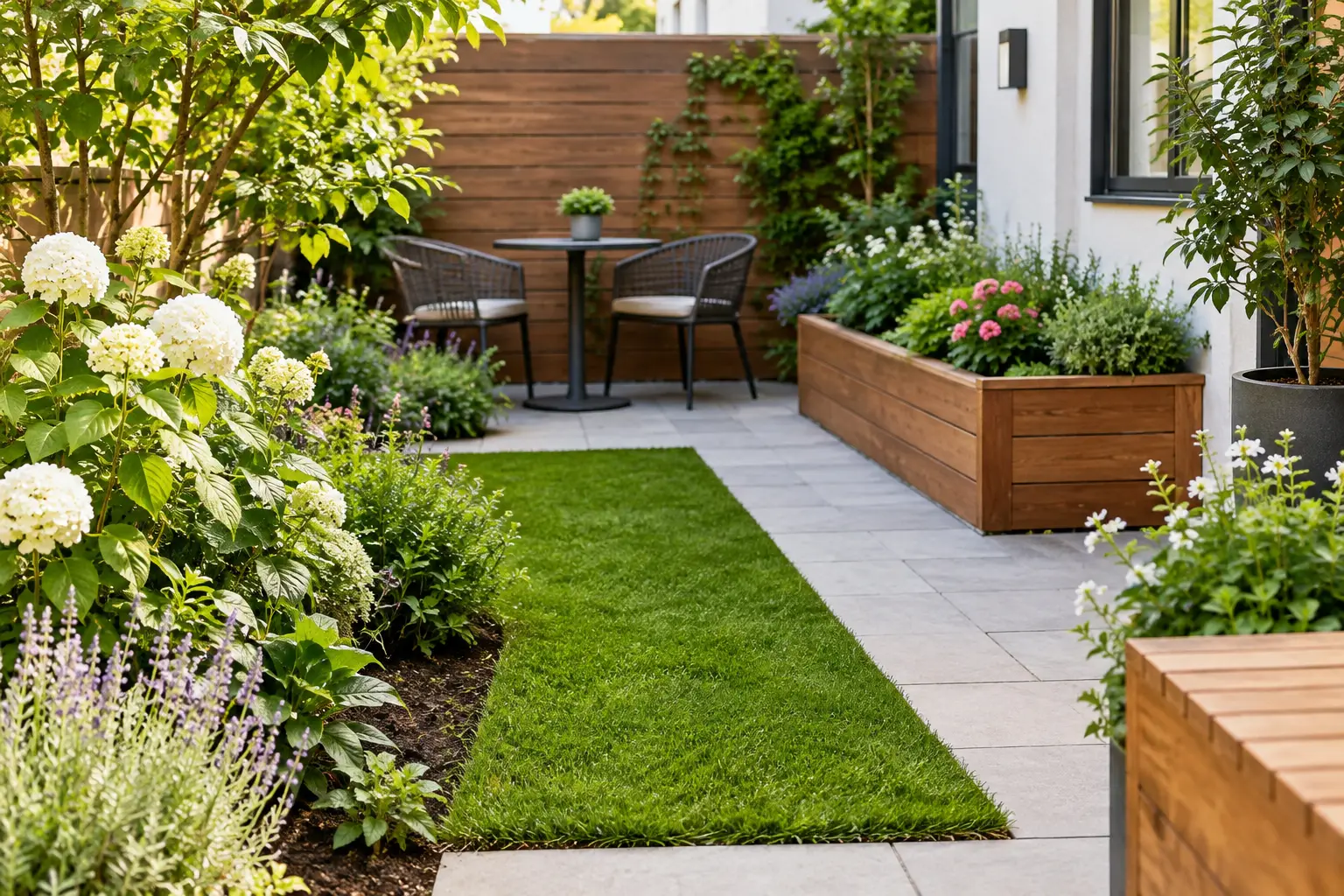
A small garden does not need to feel like a compromise. The most effective landscaping ideas for small gardens focus less on adding more and more features, and more on giving every area a clear purpose. With thoughtful levels, well-chosen materials and planting that earns its place, even a compact outdoor space can become somewhere to eat, relax, play or simply enjoy at the end of the day.
The key is to plan the garden as carefully as you would a room inside the house. A patio that is slightly too small, a path that interrupts the layout or an oversized shed can make a modest plot feel crowded very quickly. Getting the proportions right at the outset creates a garden that feels calm, useful and properly finished.
Start with how you want to use the space
Before choosing paving, plants or furniture, decide what the garden needs to do for your household. A family may need a clear area for children, practical storage and durable surfaces. A couple may place more value on outdoor dining, a quiet seating corner and lighting for evenings. If you work from a garden room, the route to and from it should feel welcoming and remain usable in wet weather.
In a small garden, trying to accommodate every possible use usually creates a cluttered result. Prioritise one main function and one supporting feature. For example, a dining patio with built-in bench seating can also work as a relaxed entertaining area, while a narrow planted border softens the boundaries without taking over valuable floor space.
Measure the plot carefully, including door swings, drain covers, existing levels and access routes. It is also worth considering where the sun falls at different times of day. The sunniest spot may be ideal for a seating area, but it may be too exposed at lunchtime without shade. A shaded side return might be better suited to storage, a living wall or ferns and other shade-tolerant planting.
Landscaping ideas for small gardens: create clear zones
A compact garden feels larger when it has structure. Rather than treating the entire plot as one open rectangle, divide it into two or three simple zones. This could be a terrace outside the house, a lawn or planted middle section, and a destination at the far end such as a bench, pergola or garden room.
The division does not need to involve walls or fences. A change in paving direction, a low step, a raised planter or a narrow strip of gravel can define an area without closing it in. Keep the transitions clean and deliberate. Too many materials and edges tend to make a small garden look busy.
Sightlines matter just as much. A focal point at the end of the garden draws the eye beyond the patio and gives the space more depth. This might be a specimen tree, a painted panel, a water bowl or a well-made timber screen. Avoid placing a large shed directly in the centre of the view from the house unless it is part of a wider, carefully designed arrangement.
Use level changes with care
A modest change in level can make a garden feel more considered, especially on a sloping plot. A raised deck or seating platform can create a distinct destination, while raised planters bring greenery closer to eye level from inside the house.
However, level changes add cost and need to be built correctly. Retaining edges, drainage and safe steps are not areas to cut corners. For gardens used by young children, older relatives or anyone with limited mobility, a largely level layout with gentle transitions may be the better long-term choice.
Choose hard landscaping that earns its space
In small gardens, the surfaces do a great deal of the visual work. One consistent paving material often looks more spacious than several competing finishes. Large-format porcelain or natural stone can create a clean, contemporary look, but the right choice depends on the property, budget and required slip resistance.
Lighter tones can help brighten a shaded garden, although very pale paving may show marks more readily. Darker materials can feel smart and grounding, but may absorb more heat in direct sun. A sample viewed outdoors is more useful than choosing solely from a brochure, as natural light can change the colour considerably.
Where space allows, use paving cuts that minimise small, awkward pieces around the edges. This is not only neater, it gives the finished garden a more professional feel. Careful falls and drainage are equally important. Water should be directed away from the property, and the finished levels should be considered alongside thresholds, air bricks and existing drainage.
Gravel can be useful for a narrow side passage or low-maintenance section, but it is not always the best choice for dining furniture, pushchairs or regular barefoot use. Artificial grass can offer a tidy green surface where natural lawn struggles, though it can become hot in summer and does not provide the same environmental benefits as real planting. The right option depends on how the area will actually be used.
Build seating and storage into the design
Freestanding furniture is flexible, but it can consume a surprising amount of room. Built-in bench seating along a boundary is one of the most practical small garden solutions. It provides generous seating without filling the middle of the patio, and the base can often be used for weather-protected storage.
Choose cushions and tables that can be stored easily, particularly if the garden is exposed. A slim table, folding chairs or a bespoke bench can work better than a large outdoor dining set. Leave enough clearance around seating for people to move comfortably – a garden only feels relaxing if it does not require everyone to squeeze past one another.
Storage should be planned early, not added as an afterthought. Bins, children’s toys, tools and garden equipment quickly undermine an otherwise well-designed space. A compact storage unit screened with matching timber, or integrated storage beneath seating, can keep essentials close at hand without becoming the dominant feature.
Use planting to soften, screen and add height
Planting is what stops a hard-landscaped garden from feeling stark. In a small plot, use fewer varieties in repeated groups rather than a different plant in every gap. Repetition creates a more settled, cohesive look and makes maintenance easier.
Think vertically as well as horizontally. Climbers on trellis, wall-mounted planters and slender multi-stem trees can provide greenery without taking up much ground space. Evergreen structure is useful throughout the year, while flowering perennials and grasses add seasonal colour and movement.
A deep border along one side can work better than narrow strips around every edge. It creates a stronger green backdrop and leaves room for a usable central area. If privacy is a concern, avoid relying solely on tall solid fencing. Layered planting, slatted screening or a pergola can provide separation while allowing light and air to move through the garden.
Be realistic about maintenance. Large containers, raised beds and well-spaced planting are often easier to manage than densely packed borders. Automatic irrigation can also be worthwhile where planting is extensive or homeowners travel regularly during warmer months.
Make the garden useful after dark
Good lighting extends the hours you can enjoy the garden and makes routes safer. Start with practical light near doors, steps and changes in level. Then add softer lighting to seating areas or key planting, rather than trying to illuminate every corner.
Warm white lighting usually feels more inviting than a harsh cool tone. Low-level wall lights, discreet spike lights and integrated lighting beneath benches or steps can all create a polished result. Position fittings carefully to avoid glare through windows or directly into seating areas.
Electrical work outdoors should be planned alongside the landscaping, especially if you expect to add a garden room, water feature or outdoor kitchen later. Installing suitable power routes while surfaces are open is far less disruptive than lifting a finished patio to add them afterwards.
Plan for a finish that lasts
The best small-garden projects are not simply attractive on completion. They remain practical through wet winters, busy family life and changing needs. That means using suitable base preparation beneath paving, protecting timber where necessary, allowing for drainage and choosing materials that suit the level of maintenance you are prepared to take on.
For more involved projects, professional coordination can make a real difference. Build 247 Construction Ltd approaches landscaping as part of the wider home, considering access, drainage, levels, structures and the finish around adjoining buildings rather than treating each element in isolation.
A small garden has very little room for wasted space or poor detail. Start with a layout that suits your daily life, invest in the groundwork and choose a restrained palette of materials and planting. The result will feel less like a leftover strip behind the house and more like a proper outdoor room you will want to use.